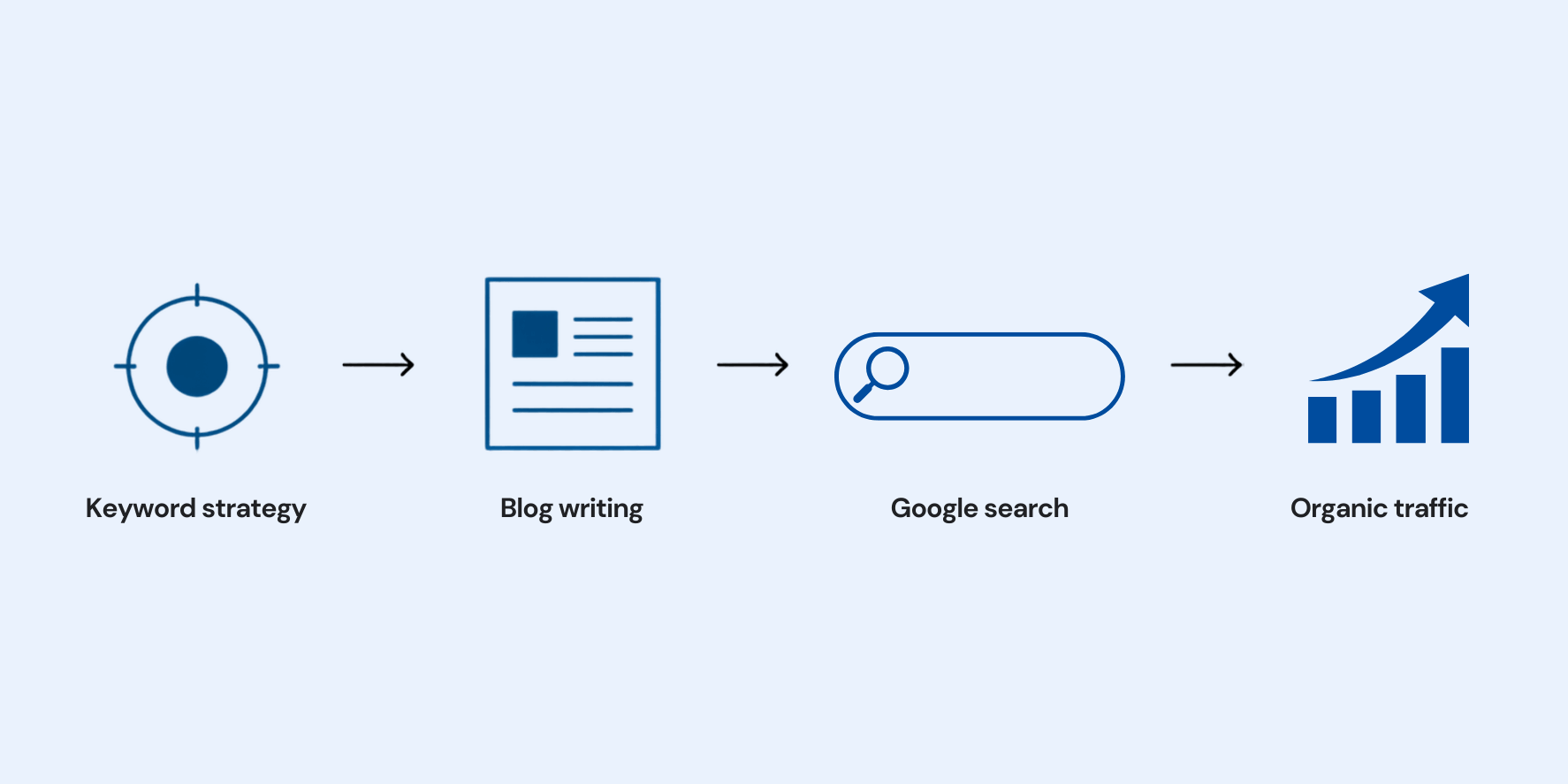
You’ve published blog after blog. You’ve shared them on LinkedIn, sent them in newsletters, maybe even asked your team to promote them. A few colleagues read them, but weeks later your analytics still look the same. Organic traffic barely moves. If this sounds familiar, you’re not alone.
Many founders assume the solution is to publish more often or write “better” content. However, neither is usually the biggest problem. More often than not, startup blogs struggle because they’re trying to compete for keywords that established companies have owned for years. That doesn’t mean SEO is out of reach.
Good SEO for startups isn’t about outspending bigger competitors or publishing hundreds of articles. It’s about finding topics your audience is already searching for and choosing keywords your website has a realistic chance of ranking for.
This guide explains why startup blogs get stuck at zero traffic, the keyword mistakes that cause it, and how you can build an SEO strategy that grows alongside your business.
TL;DR – The short version
- Publishing more content won’t fix poor keyword targeting.
- Most new startup websites compete for searches they can’t realistically rank for.
- Long-tail keywords usually offer a better path to early organic traffic.
- Building topical authority starts with solving specific customer problems.
- Small SEO wins create the foundation for ranking for broader topics later.
Key statistics — Why this matters
96.55%
of pages receive no traffic from Google, highlighting how difficult it is for content to gain visibility without a focused SEO strategy.
Source: Ahrefs Research
68%
of online experiences begin with a search engine, making organic search one of the most important channels for attracting potential customers.
Source: BrightEdge, cited by Ahrefs
~15%
of Google’s billions of daily searches are new, creating opportunities for businesses that answer niche, emerging, or highly specific questions.
Source: Google Search insights, referenced by industry research
Table of contents
- Why does your startup blog get zero traffic?
- Are you writing about the right topics for your customers?
- Why publishing more blogs rarely fixes the problem
- How can you tell if your keyword strategy is the real problem?
- How do startups choose keywords they can actually rank for?
- What keyword mistakes keep startup blogs from ranking?
- FAQs
- Conclusion
Why does your startup blog get zero traffic?
To get more organic traffic, you need to publish content that matches both what your audience is searching for and what your website can realistically rank for. Many startup blogs miss one of those two requirements, which is why they struggle to appear in search results.
Think about what usually happens. A founder launches a new SaaS product, knows content marketing is important, and starts publishing articles around broad industry topics. The content is well written, genuinely helpful, and answers real questions. Yet months later, almost nobody finds it through Google.
The issue often isn’t the quality of the writing. It’s that the topics are too competitive for a new website. For example, imagine you built a project management platform for startup teams. Your first instinct might be to write articles targeting keywords like:
- Project management software
- Task management
- Team collaboration
- Productivity software
Those topics make sense from a business perspective. The problem is that they’re also dominated by established brands with years of SEO authority and thousands of backlinks. Your audience is much more likely to search for specific problems they’re trying to solve, such as:
- How to keep remote projects on schedule
- Project planning checklist for startup teams
- How to reduce missed deadlines across departments
- Best sprint planning workflow for small product teams
Those searches may attract fewer people individually, but they’re often easier to rank for and bring in visitors with a clear intent. The same principle applies across industries.
| Startup type | Broad topic | Customer-focused topic |
|---|---|---|
| Project management SaaS | Project management software | How to organize projects for a growing startup |
| HR software | HR software | How to streamline employee onboarding for remote teams |
| CRM platform | CRM | How to follow up with leads without missing opportunities |
| Fintech startup | Expense management | How startups can track business expenses more efficiently |
Notice the difference. The first column focuses on products. The second focuses on customer problems. People often search for their problems long before they search for software.
Are you writing about the right topics for your customers?
To improve your chances of ranking, you need to build content around your customers’ questions instead of your product’s features. That’s where many startup content strategies go off course.
A common assumption is that writing about every feature your product offers will naturally attract search traffic. It rarely works that way.
Search engines aim to deliver the most helpful answer to a user’s question. If your content is centered on your product instead of the problem your audience is trying to solve, it’s less likely to match what people are actually searching for.
Let’s compare two approaches. A startup selling HR software could write an article titled: Our employee onboarding platform features. Or it could publish: How to create an employee onboarding checklist for remote hires
The second topic addresses a real challenge HR managers face. It has a clearer informational intent and creates a natural opportunity to introduce the product later, without making the article feel promotional.
“Should every blog post mention my product?”
Not necessarily. In fact, many of your highest-performing SEO articles may barely mention your product at all. Instead, they should help readers solve a specific problem. As they explore more of your content, they’ll naturally discover how your solution fits into that journey. That’s one of the biggest shifts in startup SEO strategy: stop writing the content you want to publish and start writing the content your customers are already searching for.
Why publishing more blogs rarely fixes the problem
To grow organic traffic, you need to improve the quality of your keyword strategy, not just the quantity of your content. Publishing more articles can strengthen your SEO, but only if those articles target topics your audience is actively searching for and your website has a realistic chance of ranking for.
Many startups fall into what I call the “publish and hope” cycle. The strategy usually looks like this:
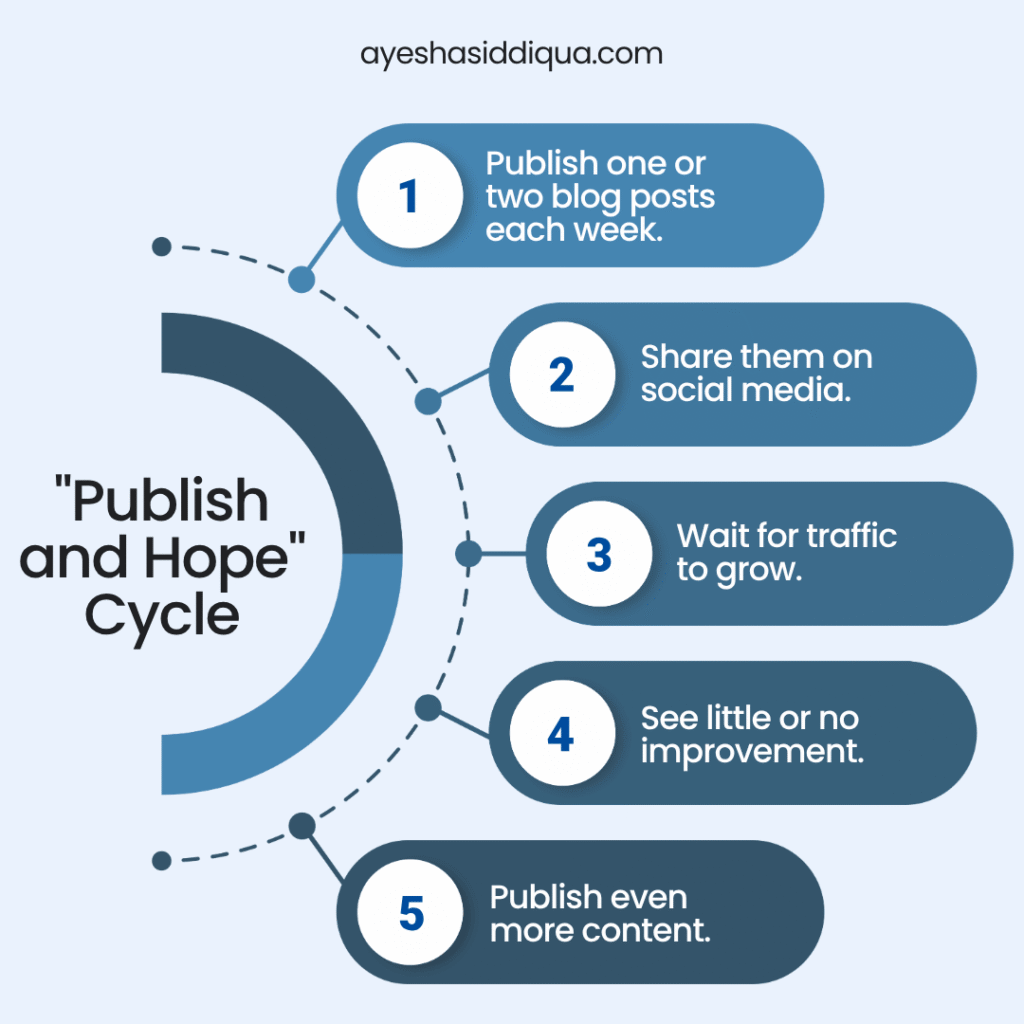
- Publish one or two blog posts each week.
- Share them on social media.
- Wait for traffic to grow.
- See little or no improvement.
- Publish even more content.
The problem isn’t consistency. Consistency is valuable. The problem is consistently publishing content that isn’t aligned with search demand or your site’s current authority.
Imagine a startup offering HR software for small businesses. Over three months, the team publishes articles like “Best HR software,” “Payroll software comparison,” “Human resource management system,” and “Workforce management platform.”
Each topic seems relevant, but they’re all highly competitive. Search results are already dominated by established software companies, review websites, and industry publications. Now compare that with a different strategy:
| Instead of targeting… | Target topics like… | Why it works |
| Best HR software | Employee onboarding checklist for startups | Solves a specific problem with lower competition. |
| Payroll software | How to pay contractors in multiple states | Matches a practical question users ask. |
| HR management system | HR compliance checklist for companies with under 50 employees | Targets a defined audience and intent. |
| Workforce management | How to create an employee handbook for a growing team | Provides actionable guidance that aligns with informational search intent. |
The second approach doesn’t ignore your product. It simply meets readers earlier in their journey, when they’re looking for answers instead of software.
Over time, publishing dozens of problem-focused articles helps search engines recognize your website as a trusted resource in your niche. That’s how startups begin building topical authority.
How can you tell if your keyword strategy is the real problem?
To diagnose your SEO performance, look beyond traffic numbers and examine whether your content is earning visibility. Even if your pages aren’t attracting clicks yet, the data often reveals whether Google understands what your content is about.
Start with these questions:
- Are your blog posts being indexed?
- Are they receiving impressions but very few clicks?
- Are they not appearing in search results at all?
- Are you targeting keywords that established competitors dominate?
One of the most useful tools for answering these questions is Google Search Console. It shows which search queries trigger your pages, how often your pages appear in search results, your average ranking position, and click-through rate (CTR). For example, suppose your CRM startup publishes an article called “How to qualify sales leads faster.” After a few weeks, Google Search Console might show:
| Metric | What it tells you |
| 1,200 impressions | Google understands the topic and is testing your page in search results. |
| 12 clicks | Your title or meta description may not be compelling enough. |
| Average position: 24 | Your content is relevant but needs stronger authority or optimization to move onto page one. |
Now compare that with a page that receives zero impressions after several weeks. That often signals a different issue. The topic may be too competitive, poorly aligned with search intent, or lacking enough context for Google to understand its relevance.
The takeaway:
Don’t assume “no traffic” always means “bad content.” Sometimes it means you’re answering the wrong question or trying to compete where your startup isn’t ready to compete.
How do keyword research for startups they can actually rank for?
To build sustainable SEO, you need to prioritize keywords that balance relevance, search intent, and realistic competition. The goal isn’t to find the biggest keyword. It’s to find the best opportunity for your current stage of growth.
A simple framework can help.
Step 1: Start with customer problems
Begin by listing the questions your ideal customers ask before they’re ready to buy. For example, if you offer accounting software for freelancers, your audience may ask: “How do I separate business and personal expenses?,” “How do freelancers prepare for tax season?,” or “What’s the easiest way to track invoices?” These questions become the foundation for keyword research for startups because they’re rooted in real customer needs.
If you’re unsure how to turn customer questions into actual keywords, you don’t need expensive SEO software or exhaustive startup SEO strategy to get started. A structured keyword research process using free tools like Google Search, Google Trends, and Search Console can help you identify realistic opportunities without investing in premium platforms. (Also read: How to Do Keyword Research for Startups Without Paid Tools)
Step 2: Expand into long-tail keywords
Look for search phrases that add context, audience, or intent. Instead of “Accounting software,” consider: “Accounting software for freelance designers,” “How freelancers can track quarterly taxes,” or “Invoice management tips for solo consultants.” Long-tail keywords typically have lower search volume, but they also tend to have lower competition and clearer intent.
Step 3: Evaluate the search results
Before committing to a keyword, search it yourself. Ask: “Are the top results from global brands?,” “Are the articles directly answering the searcher’s question?,” and “Is there an opportunity to create something more useful or more specific?” If every result comes from large, authoritative companies and perfectly satisfies the query, it may not be the best place for a new startup to begin.
Step 4: Build related content, not isolated articles
Publishing one article rarely builds authority. Publishing several related articles does. For example, a cybersecurity startup might create a content cluster like this:
| Pillar topic | Supporting articles |
| Cybersecurity for small businesses | Password policy checklist |
| How to recognize phishing emails | |
| Cybersecurity training for remote employees | |
| What is multi-factor authentication? |
Each supporting article strengthens the overall topic and signals expertise to search engines. This approach also creates meaningful internal linking opportunities, helping both users and search engines navigate your content more effectively.
You don’t need to outrank the biggest companies in your industry to succeed with SEO. You need to become the best answer for the specific questions your ideal customers are asking today. – Ayesha Siddiqua.
That’s how startups earn their first rankings, attract qualified visitors, and gradually build the authority needed to compete for broader topics in the future.
What keyword mistakes keep startup blogs from ranking?
To improve your SEO results, you need to avoid the common mistakes that prevent search engines from understanding who your content is for and why it deserves to rank. Most startup blogs don’t fail because of one major error. They lose momentum because of several small strategic mistakes that compound over time.
Here are the ones we see most often.
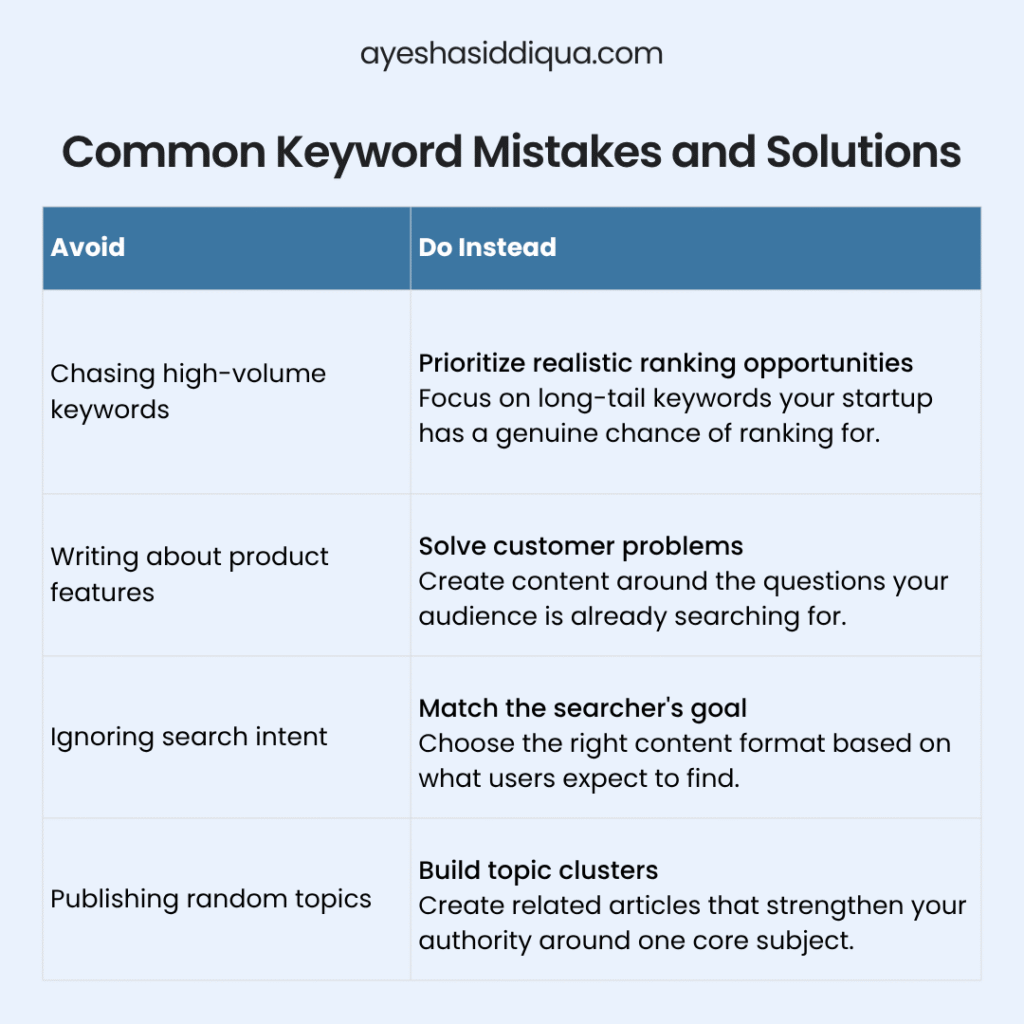
Chasing high-volume keywords
It’s tempting to target the biggest keywords in your industry because they promise the most traffic. The problem is that search volume doesn’t equal opportunity. If you’re a new CRM startup, trying to rank for “CRM software” is unlikely to produce results in the short term. A more achievable topic like “How to organize customer follow-ups without a CRM” can attract the right audience while helping you build authority.
Ask yourself: “Can my website realistically become one of the top results for this search today?” If the answer is no, look for a more specific angle.
Writing about your product instead of your customers
Your customers care about outcomes, not feature lists. For example, an expense management startup could publish: “Expense tracking software features,” or “How to stop losing business receipts when you’re constantly traveling.” The second topic addresses a real problem. It also creates a natural opportunity to introduce your product as part of the solution instead of making the article feel like an advertisement.
Ignoring search intent
Sometimes startups choose the right keyword but create the wrong type of content. Imagine someone searches: “How to build a remote onboarding process.” They’re looking for a practical guide. If your page is a product landing page, it probably won’t satisfy that search intent, no matter how well it’s written. Matching the format people expect is just as important as choosing the keyword itself.
Treating every blog as a standalone article
Every blog post should strengthen the others. Instead of publishing unrelated topics, build content around a core theme. For example, a customer support software startup might organize content like this: “Customer onboarding checklist,” “How to reduce support tickets,” “Customer self-service best practices,” or “Creating an effective knowledge base.” Together, these articles demonstrate expertise and create natural internal linking opportunities.
Key Takeaways
If your startup blog isn’t generating organic traffic yet, don’t assume SEO isn’t working. In many cases, your content isn’t failing because it’s poorly written. It’s simply competing in searches where larger, more established websites already dominate. The good news is that this is a strategy problem, not a permanent limitation. Focus on:
- Solving customer problems before promoting your product.
- Choosing long-tail keywords that align with your website’s current authority.
- Building clusters of related content instead of isolated articles.
- Using performance data to refine your keyword strategy over time.
- Being consistent with quality rather than chasing publishing volume.
SEO is rarely about finding one perfect keyword. It’s about building a library of helpful content that earns trust from both your audience and search engines. As your startup gains authority, you’ll be able to compete for broader topics. Until then, your biggest advantage is specificity.
Frequently asked questions
Why is my startup blog getting zero traffic even after publishing regularly?
Publishing consistently is only one part of SEO. If your topics target highly competitive keywords or don’t match what your audience is searching for, search engines may never surface your content. Start by evaluating your keyword strategy, search intent, and whether your articles answer specific customer questions.
How long does SEO take for a startup?
SEO is a long-term investment. While there’s no guaranteed timeline, new websites often need several months of consistent publishing and optimization before seeing meaningful organic growth. The exact timeframe depends on your competition, content quality, and website authority.
Should startups only target long-tail keywords?
Not exclusively, but they should make up the majority of your strategy in the early stages. Long-tail keywords usually have lower competition and clearer search intent, making them more realistic opportunities for newer websites while helping establish topical authority.
How many blog posts should a startup publish each month?
Quality matters more than quantity. Publishing two well-researched, customer-focused articles each month is often more effective than publishing eight articles that target overly competitive topics or lack clear search intent. Consistency is important, but relevance is what drives results.
Can I rank without backlinks?
It’s possible to rank for highly specific, low-competition searches without many backlinks. However, backlinks remain an important ranking factor for more competitive keywords. Building helpful content and earning links naturally over time is usually a more sustainable strategy than trying to acquire them quickly.
What’s the first SEO tool every startup should use?
Google Search Console is one of the best places to start because it’s free and shows how Google views your website. You can monitor impressions, clicks, indexing issues, and the search queries your pages appear for, making it an essential tool for improving your SEO strategy.