Every startup wants organic traffic. Very few have the budget for an expensive SEO stack. Search for “keyword research” and you’ll find recommendation after recommendation to subscribe to premium platforms before you’ve even written your first article. For an early-stage company, that advice can make SEO feel like a channel locked behind a monthly subscription when it’s not.
The most effective keyword research starts with understanding your customers: how they describe their problems, and what they expect to find when they search. Paid platforms can make that research faster. They surface larger datasets, estimate search volumes, and simplify competitive analysis. But they don’t replace the strategic work of identifying topics that matter to your audience.
If your website is new, your biggest challenge isn’t finding thousands of keywords, it’s finding the right ten. Publishing ten articles that genuinely solve customer problems will do more for you than chasing hundreds of broad, competitive keywords you have no real shot at ranking for.
This guide walks through a practical keyword research process built entirely on free tools and publicly available search data, so you can build your editorial calendar without paying for premium SEO software.
TL;DR – The short version
You can build an effective SEO content strategy by combining customer research with free tools like Google Search, Google Trends, Google Keyword Planner, and Google Search Console. This guide covers:
- Why keyword research doesn’t require expensive software
- How startups should think about keyword opportunities
- A practical framework for finding keywords using free tools
- How to prioritize keywords your website can realistically rank for
- The mistakes that keep new websites from gaining traction
Why this matters
Organic search remains one of the most sustainable customer acquisition channels, because helpful content keeps attracting visitors long after it’s published. Google’s own guidance emphasizes creating people-first, helpful content rather than content written to manipulate rankings, which means understanding your audience matters more than which SEO tool you use.
Sources:
Google Search Central: Creating Helpful, Reliable, People-First Content
Table of contents
- Why do so many people think keyword research requires paid tools?
- What does keyword research actually help you accomplish?
- Can you do effective keyword research without paid tools?
- Which free tools should you actually use?
- How do you know if a keyword is worth targeting?
- What mistakes should you avoid?
- Conclusion
- FAQs
Why do so many people think keyword research requires paid tools?
Because most keyword research tutorials are written for mature marketing teams, not startups. If you’re managing SEO across hundreds of pages or multiple sites, premium tools are worth the investment, they save time by centralizing keyword ideas, backlink data, ranking reports, and competitor analysis. But that’s a very different job from a founder publishing their first ten blog posts.
Say you’ve just launched a B2B SaaS product that helps HR teams automate employee onboarding. You don’t need a database of 25 million keywords. You need answers to a handful of specific questions:
- What problems are HR managers searching for?
- Which topics match our product expertise?
- What can we realistically rank for as a new website?
- Which articles are most likely to attract qualified visitors?
None of those answers require expensive software. They require understanding your audience.
One of the biggest misconceptions in SEO is that keyword research starts with data. When actually, it starts with customer problems. – Ayesha Siddiqua.
A premium SEO platform can tell you that thousands of people search for a broad topic like “employee onboarding.” It can’t tell you which onboarding challenges your ideal customers struggle with every day. Only conversations with customers, support tickets, product demos, sales calls, and community discussions can reveal that. That’s why startups should treat keyword research as a business exercise first and an SEO exercise second.
Should you wait until you can afford Ahrefs or Semrush before investing in SEO? No, waiting delays the one thing every new website needs most: publishing helpful content consistently. Your first objective isn’t a perfect keyword database. It’s building topical authority around the problems your business is uniquely qualified to solve. Premium tools improve efficiency later; they don’t replace customer understanding, strategic thinking, or consistent publishing now.
What does keyword research actually help you accomplish?
Keyword research helps you understand what your audience is trying to achieve, not just what they’re typing into Google. Every search represents a person trying to solve a problem, answer a question, compare options, or make a decision. Your job isn’t to collect keywords, it’s to understand those underlying needs well enough to create genuinely useful content.
Back to the HR onboarding example: you could target a broad keyword like “employee onboarding.” Or you could explore the specific questions HR managers are actually asking: “How to automate employee onboarding paperwork,” “Employee onboarding checklist for remote teams,” “Onboarding software for small HR teams,” “How to reduce new hire onboarding time,” or “Employee onboarding email templates.”
The second approach wins. Instead of competing with thousands of established sites for one broad term, you’re creating content around problems your ideal customers are actively trying to solve, which is exactly why long-tail keywords matter for newer websites. They’re more specific, easier to satisfy, better aligned with search intent, and more likely to attract visitors who actually convert. Before opening any keyword tool, ask yourself:
- What questions do prospects ask during demos?
- Which features need the most explanation?
- What problems do customers repeatedly mention?
- What misconceptions slow down purchasing decisions?
- What would someone search before they even know our product exists?
The Insight
Those questions almost always become your best content ideas. Great keyword research isn’t about discovering popular phrases, it’s about discovering the customer problems your business is best positioned to solve.
Can you do effective keyword research without paid tools?
Yes, and for most startups, it’s the smartest place to start. When your website is new, your biggest constraint isn’t access to keyword data, it’s building enough topical authority for search engines to trust your content in the first place. A paid platform won’t improve your rankings if the content underneath it doesn’t answer what people are actually searching for.
So instead of asking “what keywords have the highest search volume,” ask “what questions can my business answer better than anyone else?” That small shift changes your entire content strategy. Will you miss some valuable keyword opportunities without premium tools? Probably a few. But you won’t miss the opportunity to build topical authority, and that matters more.
A simple keyword research framework for startups
Follow this five-step workflow every time you plan new content.
| Step | Goal | Outcome |
| 1. Start with customer problems | Identify real questions | Seed topics |
| 2. Expand keyword ideas | Discover search variations | Keyword list |
| 3. Validate search intent | Understand what Google rewards | Content format |
| 4. Prioritize opportunities | Choose realistic targets | Editorial priorities |
| 5. Build your content plan | Turn keywords into publishable articles | SEO roadmap |
Step 1: Start with customer problems
The best keyword ideas rarely come from SEO tools, they come from conversations. Think about the questions customers ask before they buy. Say you’re building payroll software for small businesses. Instead of brainstorming keywords, start by listing the questions your customers actually ask: “How do I process payroll for my first employee?,” “What payroll taxes should startups pay?,” “How often should employees be paid?,” or “Can payroll be automated?.”
These aren’t keywords yet, they’re customer problems. That’s exactly where effective keyword research begins. Good places to collect them: sales calls, product demos, support conversations, Reddit communities, LinkedIn comments, industry Slack groups, product reviews, and founder interviews. By the time you open Google, you’ll already know what you’re looking for.
Step 2: Expand your ideas using free search features
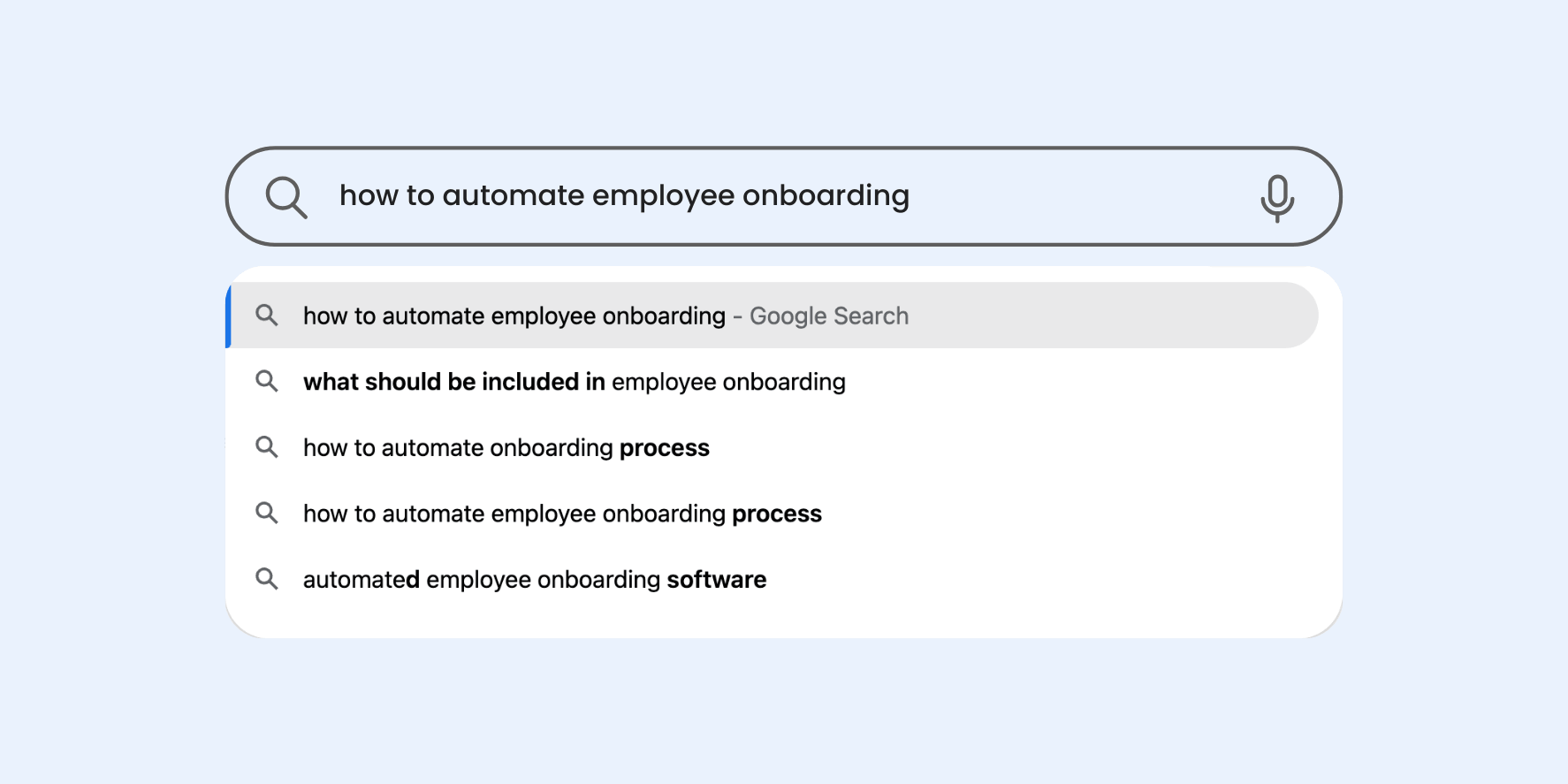
Now see how people actually search. Type your seed topic into Google and pay attention to Autocomplete, People Also Ask, Related Searches, and featured snippets, all generated from real search behavior, and all rich with long-tail opportunities. Say your seed topic is “startup payroll.” Google might surface: “startup payroll checklist,” “payroll software for startups,” “startup payroll taxes,” “startup payroll guide,” and “how to run payroll for a startup.”
Each suggestion is another article idea. Google tells you what people search for; communities tell you why. Reddit, Quora, and LinkedIn discussions often reveal the exact language customers use, someone asking “is payroll software worth it for a company with only five employees?” is handing you an entire article on a plate.
Step 3: Validate search intent
This is where most beginners go wrong: a keyword isn’t automatically suitable for a blog post. Always search it first, look at the first page of results, and ask what Google is already rewarding, educational content, product pages, comparison articles, or videos. Match that expectation rather than guessing.
| Search Query | Search Intent | Best Content Format |
| How to calculate startup payroll | Informational | Blog guide |
| Best payroll software | Commercial investigation | Comparison article |
| Payroll software pricing | Transactional | Product page |
If Google is ranking tutorials, don’t publish a landing page. If Google is ranking comparisons, don’t write a beginner’s guide. Search intent should shape your content before you write a single paragraph.
Step 4: Prioritize realistic opportunities
Not every keyword deserves your attention, especially on a new website. Run each one through five questions:
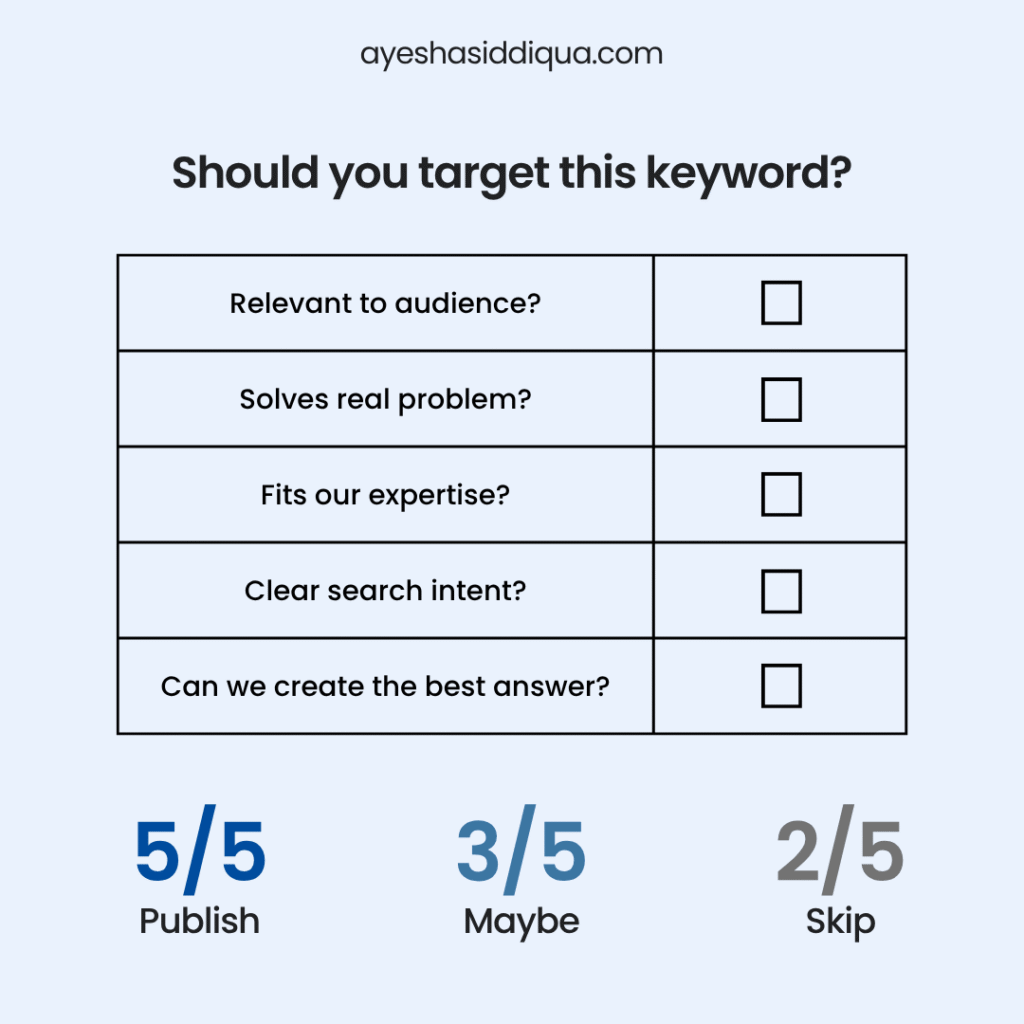
If you answer yes to all five, you’ve likely found a worthwhile topic. Notice what’s missing from that list: search volume. That’s deliberate. For startups, relevance usually beats popularity, one article that consistently attracts qualified visitors is often worth more than thousands of untargeted impressions.
That doesn’t mean you should avoid competitive keywords forever. Treat them as long-term goals. Build authority with specific, lower-competition content first, and you’ll naturally become more competitive for broader topics as your site grows.
Which free tools should you actually use?
A handful of free resources cover almost every stage of keyword research.
| Tool | Best for | Why use it? |
| Google Search | Discovering keyword ideas | Autocomplete, People Also Ask, and Related Searches reflect real user behavior |
| Google Keyword Planner | Expanding keyword lists | Identifies related search terms and approximate demand |
| Google Trends | Validating trends | Compares topics and surfaces growing or seasonal interest |
| Google Search Console | Finding existing opportunities | Shows which queries already generate impressions for your site |
| Understanding customer language | Reveals authentic questions and pain points | |
| YouTube Search | Tutorial-focused topics | Great for surfacing educational search queries |
How do you know if a keyword is worth targeting?
The best keyword isn’t the one with the highest search volume, it’s the one that helps the right reader solve the right problem. Before adding anything to your editorial calendar, run it through four criteria: relevance (does this matter to our ideal customer?), search intent (can we satisfy what people expect?), business value (does this connect to our product or expertise?), and competition (can we realistically produce a better resource?).
Say you sell project management software for startups. Which topic would you choose?
| Keyword | Better choice? | Why |
| Project management | No | Extremely broad and highly competitive |
| Agile sprint planning template for startup teams | Yes | Specific audience, clear intent, realistic competition |
The second topic will attract fewer searches, but the people who find it are far more likely to become customers. Keyword research isn’t about finding the biggest opportunity. It’s about finding the best opportunity for your business today.
Choosing the right keywords is only one part of the equation. If your startup blog still isn’t attracting organic traffic, the issue may also be your overall content strategy, search intent, or the competitiveness of the topics you’re targeting. My other blog, SEO for Startups: Why Your Blog Gets Zero Traffic, explores these common challenges and explains why many new websites struggle to gain visibility even with well-written content.
What mistakes should you avoid?
Most keyword research mistakes happen because marketers prioritize search volume over customer value. Avoiding a few common pitfalls will do more for your content strategy than adding another tool to your workflow.
1. Starting with keywords instead of customer problems.
If your first step is opening a keyword tool, you’ve already skipped the most important part of the process. Start by asking what questions customers repeatedly ask, what challenges they’re trying to solve, and what information would help them decide. Keywords should validate your ideas, not create them.
2. Chasing high-volume keywords too early.
Broad topics like “SEO,” “project management,” “CRM,” or “email marketing” are dominated by established sites with years of authority behind them. A startup gains traction far faster by answering specific questions: “how to choose a CRM for a small sales team” instead of “CRM.” Ten focused articles will consistently outperform one overly ambitious one.
3. Ignoring search intent.
Even a great keyword performs poorly if the content format doesn’t match what searchers expect. Spend five minutes reviewing the top-ranking pages before you write: are they guides, comparisons, product pages, or videos? Your content should fit the intent behind the search, not just include the keyword.
4. Measuring success only by rankings.
Ranking #1 isn’t the goal, attracting the right audience is. A keyword that brings 300 qualified visitors genuinely interested in your product beats one that brings 10,000 visitors who bounce immediately. Track metrics that actually support business growth: qualified organic traffic, engagement time, newsletter sign-ups, demo requests, trial sign-ups, and conversions.
And if you pick the wrong keyword?
That’s fine, keyword research isn’t a one-time decision. As your site grows, you’ll learn which topics resonate. Review performance regularly, update older articles, and refine your plan based on real data instead of assumptions.
Key Takeaways
Keyword research doesn’t begin with software, it begins with understanding your audience. If you’re building a startup, your biggest competitive advantage isn’t access to premium SEO tools. It’s your ability to understand customer problems and solve them better than anyone else.
Start with customer conversations, validate ideas through free search resources, and prioritize realistic opportunities, and you’ll build a sustainable SEO strategy without stretching your marketing budget. Premium tools can help you work more efficiently as your content library grows, but they should support your strategy, not define it.
The best keyword isn’t the one with the highest search volume. It’s the one that helps the right customer solve the right problem. Build around that, and your content will keep creating value long after it’s published.
Frequently Asked Questions
1. Can I really do keyword research without paying for SEO tools?
Yes. For most startups and small businesses, free tools provide more than enough to identify valuable content opportunities. Google Search, Google Trends, Google Keyword Planner, and Google Search Console can help you discover keywords, understand search intent, and monitor performance. Premium tools become more valuable as your content operation scales, but they aren’t required to build a strong SEO foundation.
2. What is the best free keyword research tool?
There isn’t a single “best” tool, because each serves a different purpose. Google Search is excellent for discovering real search queries, Google Keyword Planner helps expand keyword ideas, Google Trends validates interest over time, and Google Search Console reveals the queries your existing pages already get impressions for. Used together, they form a well-rounded research workflow.
3. Should I prioritize search volume?
Not always. For newer websites, relevance and competition usually matter more than search volume. A keyword with modest traffic but strong alignment to your audience can generate more qualified visitors than a broad keyword that’s hard to rank for. Solve meaningful customer problems first.
4. How many keywords should one blog post target?
A well-optimized article should focus on one primary keyword supported by several closely related secondary and semantic keywords. This keeps the content focused while letting it rank for multiple relevant search queries naturally.
5. What are long-tail keywords?
Long-tail keywords are longer, more specific search phrases that usually signal clearer search intent. They tend to have lower competition and attract visitors looking for a precise answer, making them ideal targets for startups and newer websites building topical authority.
6. When should I invest in paid SEO tools?
Once your website has an established, consistent publishing process. At that stage, premium platforms help you find additional opportunities, monitor rankings, analyze competitors, and scale more efficiently. Until then, mastering the fundamentals with free tools offers a better return on investment.