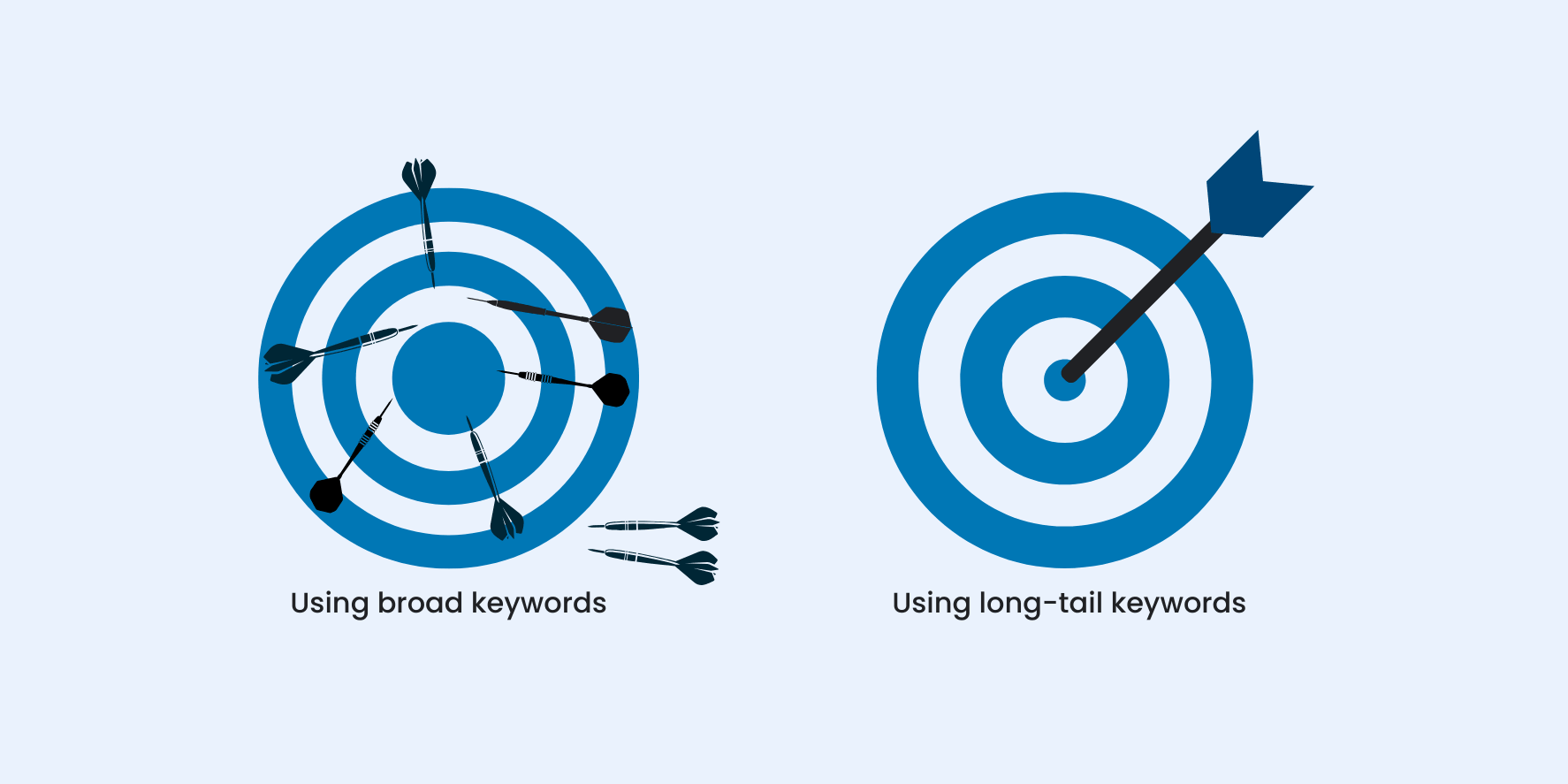
Launching a new website is frustrating when every keyword you care about is already dominated by companies with years of authority and hundreds of backlinks. Most startups don’t struggle because they create poor content. They struggle because they’re trying to rank for searches they have very little chance of winning.
Long-tail keywords offer a more realistic starting point. They help startups compete where search intent is clearer, competition is often lower, and content has a better chance of reaching the first page. If your goal is steady SEO growth instead of chasing vanity metrics, they deserve a place in your keyword strategy.
TL;DR – The short version
- Long-tail keywords usually have lower competition than broad keywords.
- They match specific search intent, making content more useful.
- Startups can build topical authority by answering focused questions.
- Ranking for several smaller keywords often drives more qualified organic traffic than competing for one broad term.
- Long-tail keywords are a practical way to grow SEO before your website has established authority.
Key statistics
Around 15% of Google searches are new every day, showing how varied and specific search behavior can be.
Source: Google
Google’s ranking systems prioritize content that is helpful and created for people rather than search engines.
Source: Google Search Central
Search intent is one of the core concepts behind Google’s helpful content guidance.
Source: Google Search Central
Table of contents
Why broad keywords slow startups down
Many founders begin keyword research by looking at search volume. It feels logical to target the terms that thousands of people search every month. The problem is that those keywords are usually the same ones established companies have been investing in for years.
Take an example of a project management startup. Trying to rank for “project management software” means competing against companies with large content libraries, strong backlink profiles, and high domain authority. Publishing one article is unlikely to change that.
A more realistic approach would be targeting searches such as “project management software for remote engineering teams” or “project management software for startup product teams.” These searches may have lower volume, but they are also more focused and often less competitive.
For an early-stage website, winning several smaller opportunities usually produces better results than chasing one large keyword.
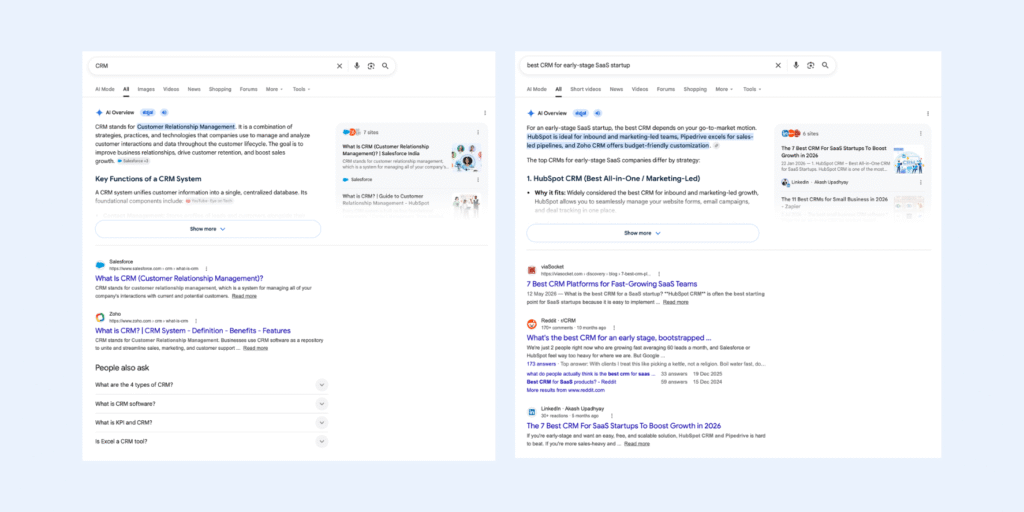
Notice how Google’s results change as the search becomes more specific. The broad query is filled with well-established companies, while the long-tail search surfaces content tailored to a particular audience. That’s the opportunity long-tail keywords create: they help startups compete by answering a more focused question instead of trying to win the broadest one.
Why long-tail keywords are easier to rank for
The advantage of long-tail keywords is not simply that they are longer. The real advantage is that they describe a very specific need.
Someone searching for “CRM” could be researching definitions, comparing vendors, or looking for enterprise software. Google has to satisfy many possible intentions.
Someone searching for “best CRM for early-stage SaaS startup” leaves much less room for interpretation. The search intent is clearer, which makes it easier to create content that directly answers the question.
When your content closely matches what people are looking for, Google has a stronger reason to surface it.
This doesn’t mean every long-tail keyword has low keyword difficulty. Some are highly competitive. But many opportunities exist where startups can realistically compete because fewer websites have created focused content around those searches.
How search intent improves your chances of ranking
Search intent is often more important than search volume. I’ve reviewed content from startups that targeted high-volume keywords yet attracted visitors who never became customers. The articles ranked for broad informational searches but answered questions unrelated to the product or audience.
Long-tail keywords naturally narrow the audience. While fewer people search for them, the visitors who do are usually looking for something specific.
Consider the difference below.
| Broad keyword | Long-tail keyword |
| HR software | HR software for companies with under 100 employees |
| CRM | CRM for B2B SaaS startups |
| Developer tools | API monitoring tools for small engineering teams |
| Fintech software | Accounting software for fintech startups |
The second column tells you much more about what the reader wants. That clarity makes it easier to write useful content and improves the likelihood of ranking for the right searches.
Many startups struggle because they optimize for the wrong keywords from the beginning. If your blog isn’t gaining traction despite publishing consistently, these are some of the most common keyword mistakes that keep startup blogs from ranking and how to avoid them.
What this looks like in a startup
Suppose you’re building a healthcare SaaS product. Instead of writing one broad article targeting “patient scheduling software,” you might publish separate articles around questions your audience is actually asking. For example:
- Patient scheduling software for small clinics
- How to reduce appointment no-shows with scheduling software
- HIPAA considerations for online appointment scheduling
Each article solves one problem instead of trying to cover everything. Together, they build topical relevance around your product area while giving Google multiple opportunities to understand what your website is about.
This approach also makes future content planning much easier. Every article becomes part of a larger content ranking strategy instead of existing as an isolated post.
When long-tail keywords are not enough
Long-tail keywords are a starting point, not the entire strategy. If the content doesn’t answer the search clearly, ranking will still be difficult. The same applies if your website is technically slow, difficult to navigate, or lacks credibility.
It’s also good to remember that keyword research should support business goals. Publishing articles simply because they have low competition rarely produces meaningful results if those topics have little connection to your product or audience. A good keyword strategy balances three questions:
- Is someone searching for this?
- Can we realistically rank for it?
- Does this topic help the right customer?
When all three answers are yes, you’ve found a much stronger opportunity than search volume alone can reveal.
Building long-term SEO growth
Most startups won’t become visible on Google because they publish more articles than everyone else. They become visible because they consistently answer questions their competitors overlook.
Long-tail keywords make that possible. They encourage you to focus on specific customer problems instead of broad industry terms. Over time, those focused articles build authority, attract relevant organic traffic, and create a stronger foundation for ranking on more competitive keywords later.
That’s why I usually recommend starting small. A collection of useful articles targeting realistic opportunities is far more valuable than a handful of ambitious posts that never gain visibility.
Of course, choosing realistic opportunities starts with good keyword research. If you’re working on a budget, here’s how to do keyword research without paid tools.
Key Takeaways
Long-tail keywords help startups rank on Google faster because they align with how new websites actually grow. They reduce unnecessary competition, make it easier to satisfy search intent, and help you build authority one focused topic at a time.
They won’t replace good content or eliminate the need for a broader SEO strategy. But they give startups a practical way to earn visibility before they have the authority to compete for highly competitive terms.
If you’re planning your next few articles, don’t start by asking which keyword has the highest search volume. Start by asking which question your ideal customer is searching for that established competitors haven’t answered well.
FAQs
Do long-tail keywords always have low competition?
No. Some long-tail keywords are highly competitive. It’s better to evaluate keyword difficulty and the quality of existing search results than assume every longer phrase is easy to rank.
How many long-tail keywords should one article target?
Usually one primary keyword with a handful of closely related supporting keywords is enough. Trying to target many unrelated searches often weakens the article’s focus.
Are long-tail keywords only useful for new websites?
No. Established websites also benefit from them because they capture highly specific searches and often attract visitors with stronger purchase intent.
Should I choose search volume or search intent?
If you have to choose one, prioritize search intent. A smaller audience looking for exactly what you offer is usually more valuable than a large audience with unclear needs.
Can long-tail keywords improve conversions?
Often, yes. People using specific searches generally know more about what they’re looking for, which means they’re more likely to engage with relevant products or resources.